01
Challenge
Complex Regulatory Compliance Across Multiple Frameworks
Our Solution
Compliance-driven platforms aligned with SAMA, IFRS 9, AML, PDPL and CMA requirements
Legacy systems cannot keep pace with modern market demands or shifting compliance mandates. We provide the modular lending engines, automated risk evaluation tools and expert advisory you need to scale safely within CMA and Saudi Central Bank (SAMA) regulations. Natively aligned with local regulatory operational frameworks for immediate deployment in Riyadh, KSA.
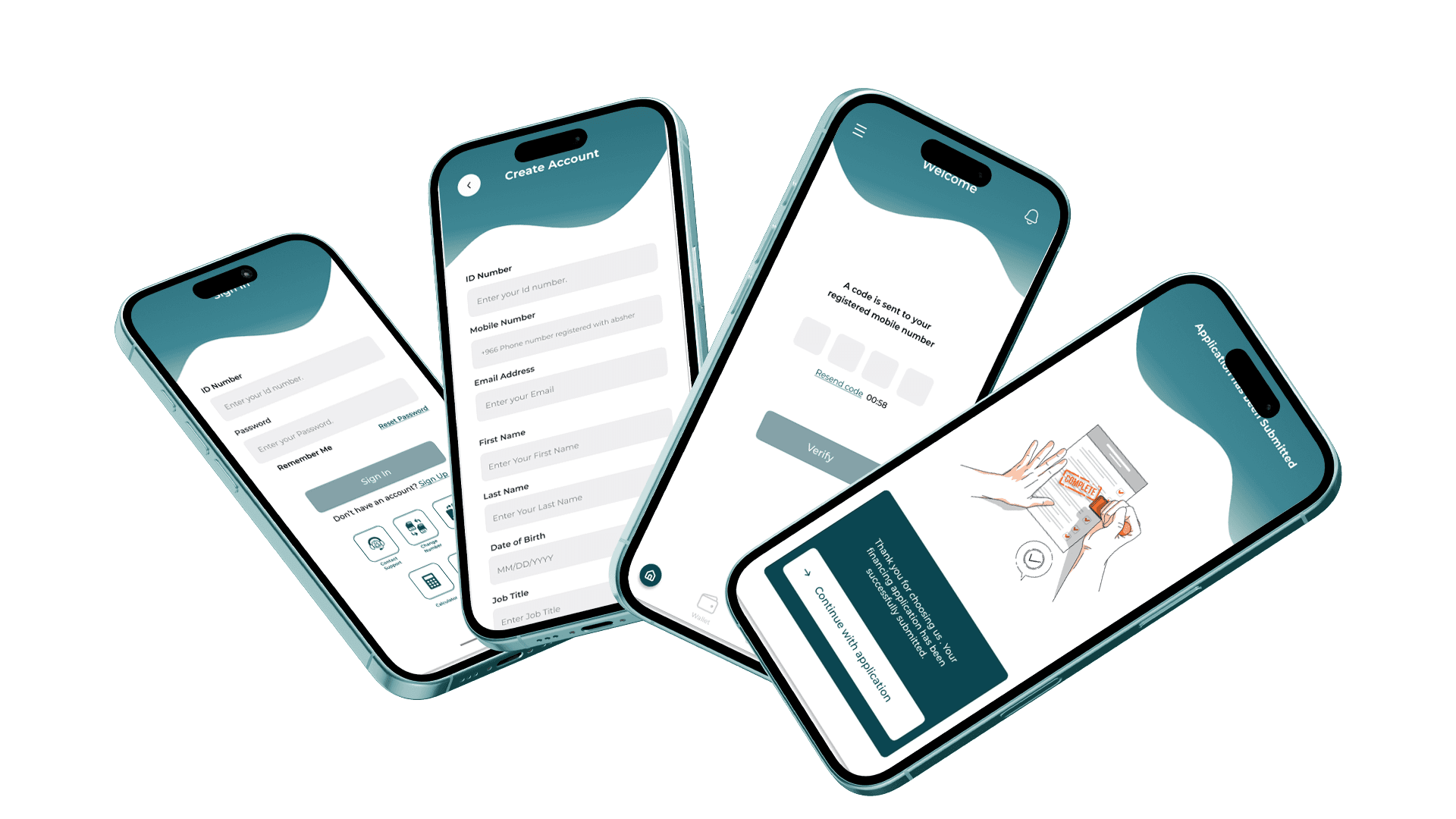
The Neo Solutions helps financial institutions modernize lending, strengthen compliance and improve digital growth through enterprise software, strategic advisory and innovative technology. With years of industry expertise and a deep understanding of regulated financial environments, we deliver scalable solutions that support sustainable growth, operational excellence and long-term business success.
Financial institutions face growing regulatory and operational demands. We help simplify these challenges with practical technology and expert guidance.
Challenge
Complex Regulatory Compliance Across Multiple Frameworks
Our Solution
Compliance-driven platforms aligned with SAMA, IFRS 9, AML, PDPL and CMA requirements
Challenge
Manual Lending And Approval Processes
Our Solution
Automated digital lending workflows from onboarding to servicing
Challenge
Legacy Systems Slowing Innovation
Our Solution
Modern enterprise solutions that integrate with existing banking infrastructure
Challenge
Increasing Operational Costs
Our Solution
Intelligent automation that reduces manual effort and improves efficiency
Challenge
Fragmented Customer Experiences
Our Solution
Connected digital ecosystems delivering seamless customer journeys
Challenge
Growing Cybersecurity Threats
Our Solution
Secure architectures backed by cybersecurity advisory and governance expertise
Challenge
Limited Portfolio Visibility
Our Solution
Real-time reporting and analytics for better decision-making
Challenge
Scalability Challenges
Our Solution
Modular platforms designed to grow with your business
Our financial platforms support every stage of the lending journey, helping teams work faster, make informed decisions, and stay compliant.

Digitize customer onboarding, document verification, underwriting, approvals and loan origination through automated workflows that improve speed, accuracy and compliance.
Book a demo
Manage repayments, servicing, schedules, restructures, settlements and portfolio administration from one centralized platform.
Book a demo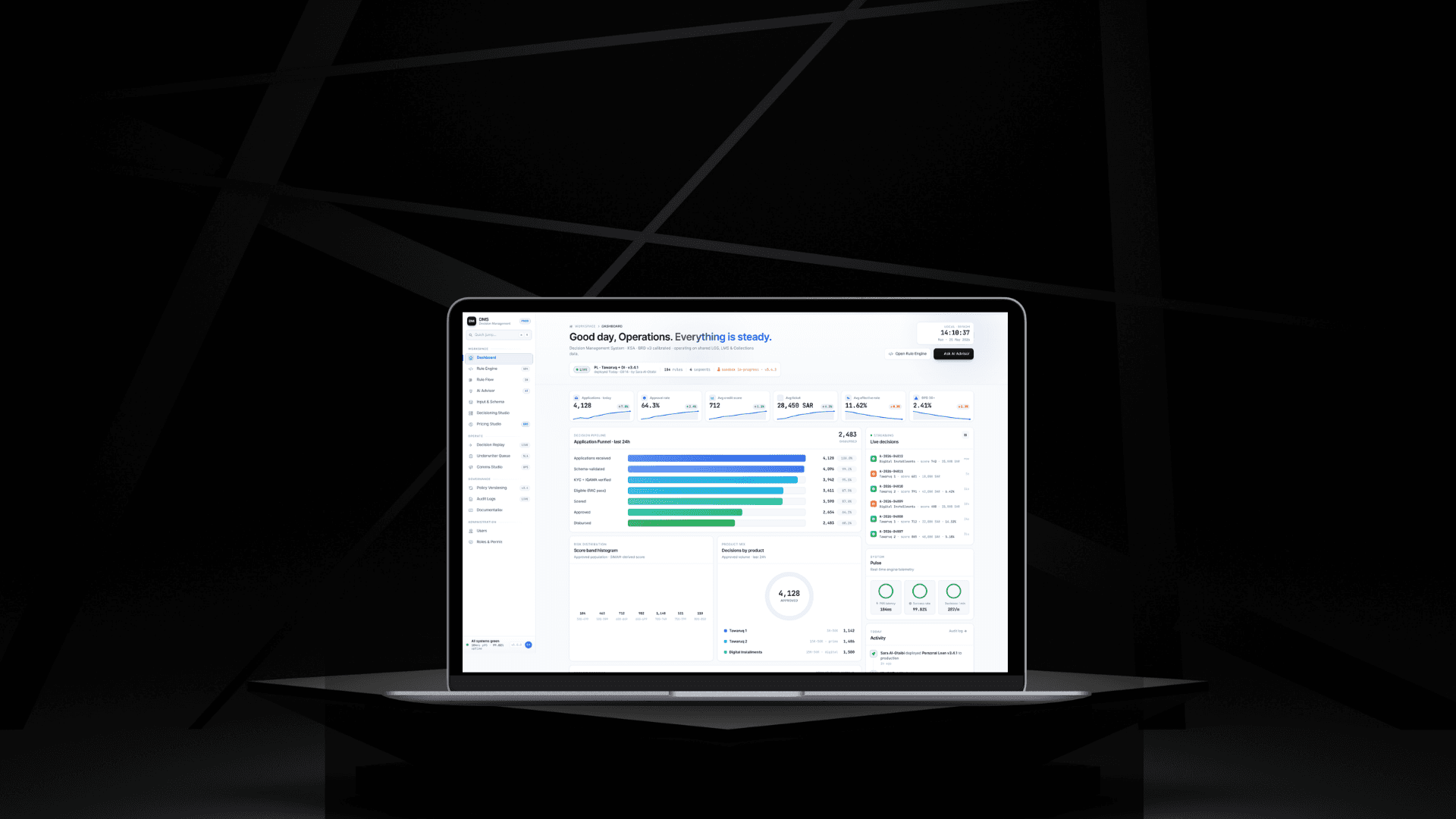
Automate lending decisions using configurable business rules, credit policies and intelligent decision engines for faster approvals.
Book a demo
Improve collections through automated recovery strategies, delinquency monitoring, payment tracking and customer engagement.
Book a demo
Support impairment calculations and financial reporting with intelligent credit risk modeling aligned to IFRS 9 requirements.
Book a demo
Automate accounting entries, reconciliation, financial reporting and seamless integration between lending operations and finance.
Book a demoFrom software development to cloud and AI solutions, we build reliable technology that supports long-term business growth and operational efficiency.
Develop secure enterprise web applications that improve operational efficiency and customer engagement.
Book a demo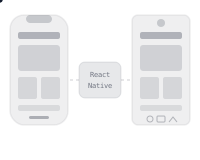
Create intuitive mobile experiences that enable financial services anytime, anywhere.
Book a demo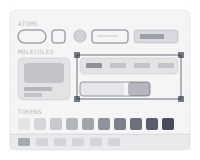
Design customer-centric digital experiences that simplify complex financial workflows.
Book a demo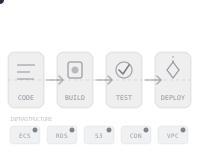
Modernize infrastructure with secure cloud deployment, automation and continuous delivery practices.
Book a demo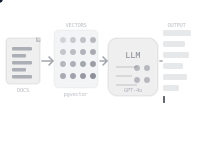
Leverage intelligent automation and predictive analytics to improve decision-making and operational performance.
Book a demo
Build scalable cloud-native enterprise applications designed for long-term business growth.
Book a demoWork with experienced advisors who help strengthen governance, manage risk, and support regulatory requirements with practical business strategies.
Strengthen cyber resilience, security governance, compliance readiness and enterprise risk protection.
Improve financial performance through transaction optimization, governance, reporting and regulatory alignment.
Develop comprehensive risk management frameworks that strengthen lending decisions, portfolio quality and regulatory compliance.
Optimize business operations through process redesign, workflow automation, governance improvements and operational excellence.
Our support team works alongside your business to keep systems running smoothly, resolve issues quickly, and maintain consistent performance.
Book a demoResponsive assistance for day-to-day technical requests and operational support.
Rapid response for critical business issues requiring immediate expert attention.
Efficient identification, resolution and prevention of operational disruptions.
Dedicated teams providing proactive monitoring and ongoing platform management.
Ensure every system update is deployed safely with minimal business disruption.
Continuously improve system performance, scalability and operational efficiency.
Expert guidance throughout deployment, configuration, testing and production rollout.
Equip your teams with practical knowledge to successfully adopt the platform.
Provide comprehensive technical, operational and user documentation for every solution.
Securely migrate applications, customer data and business processes with minimal downtime.
Work with The Neo Solutions to build lasting partnerships that create new opportunities, strengthen capabilities and support shared business goals.
Deliver enterprise financial technology under your own trusted brand.
Collaborate to accelerate innovation and expand market opportunities.
Connect seamlessly with banking platforms, APIs and third-party solutions.
Partner with industry experts delivering specialized transformation initiatives.
Develop integrated solutions powered by modern technologies and shared expertise.
Expand your market reach through mutually beneficial distribution partnerships.
Create new business opportunities through trusted referral relationships.
Collaborate on enterprise implementations with shared delivery excellence.
Ready to explore a partnership model that fits your growth plans?
Book a demoSee how organizations have improved lending operations, strengthened compliance and achieved measurable results by working with our experienced team.
“
The financial sector within the Kingdom of Saudi Arabia is undergoing a major structural shift. Guided by the Financial Sector Development Program of Vision 2030, traditional credit underwriting is rapidly yielding to automated credit architectures. For local commercial banks, specialized finance companies, and digital credit providers in Riyadh and across the Kingdom, the mandate is clear: credit operations must achieve high structural efficiency while adhering closely to the regulatory updates issued by the Saudi Central Bank (SAMA).
Deploying a modern SAMA-compliant lending platform requires more than replacing paper forms with digital portals. It demands a thorough architectural alignment with stringent data residency rules, cybersecurity frameworks, consumer protection codes, and Sharia compliance principles. As financial institutions scale up their operations to meet growing credit demands, selecting and integrating a proper Saudi digital lending platform becomes a core operational priority. This analysis details the technical foundations, ecosystem integrations, and operational best practices required to establish a fully compliant, highly efficient automated lending operation in the Kingdom.
By moving away from manual verification steps, financial institutions can establish a faster, more dependable lending pipeline. This shift supports the broader goal of expanding financial inclusion throughout the Kingdom, ensuring that both individual consumers and small-to-medium enterprises (SMEs) can access credit when they need it most. The challenge lies in balancing this operational speed with the deep regulatory compliance that SAMA demands. Achieving this balance requires a modular, well-designed technology stack that is built specifically for the unique legal and financial frameworks of Saudi Arabia.
Operating a financing business in the Kingdom requires absolute adherence to SAMA mandates. The regulator maintains oversight to protect consumers, guarantee systemic stability, and block financial crimes such as money laundering and terrorist financing. Any technology deployed to manage credit must have these regulatory rules written directly into its code, ensuring that compliance is maintained automatically at every step of the loan lifecycle.
SAMA rules for consumer financing dictate clear limits on debt burden ratios. For instance, the total monthly deduction against an applicant's salary cannot exceed specified thresholds unless specific wealth or collateral criteria are satisfied. A compliant SAMA-regulated loan management system must include these limits directly within its automated underwriting code. For example, for salaried employees earning standard wages, the Debt Burden Ratio (DBR) must be strictly calculated using the following formula:
For retired individuals, this ratio is restricted even further to protect vulnerable consumers. A modern Saudi lending software deployment must automatically retrieve all active obligations, apply these calculations, and deny or adjust the requested loan amount without human intervention if the ratio is exceeded.
Furthermore, regulations require absolute transparency regarding the Annual Percentage Rate (APR). The underlying calculations for the APR, including all administrative fees, insurance costs, and profit margins, must be clearly shown to the borrower prior to contract execution. Any automated system must preserve a clear auditable trail of these disclosures to satisfy periodic regulatory reviews. This disclosure must be presented in clear, simple language, ensuring the customer understands the exact cost of borrowing over the entire duration of the agreement.
Data sovereignty is a strict requirement for financial operations within Saudi Arabia. Under SAMA governance rules and National Data Management Office (NDMO) standards, all sensitive consumer data, financial records, credit histories, and identity metrics must be processed and stored inside the physical boundaries of the Kingdom.
Cloud deployments must utilize local data centers certified by the Communications, Space and Technology Commission (CST) and approved by SAMA. Utilizing a secure lending platform KSA requires that no personally identifiable information (PII) or financial transactional data leaves the borders of Saudi Arabia for processing, hosting, or third-party analysis. This means that multi-tenant software-as-a-service (SaaS) platforms hosted on international public clouds are entirely non-compliant unless they offer a dedicated, physically isolated instance located within a certified Saudi Arabian data center.
A modern commercial or retail credit operation needs an integrated architecture that handles everything from the initial customer touchpoint to final loan payoff. This architecture consists of three main systems: the customer acquisition front-end, the middle-tier decision engine, and the core servicing ledger.
The front-end system acts as the primary onboarding mechanism for both individuals and corporate entities. A loan origination system in Saudi Arabia must deliver a clear onboarding experience while collecting necessary verification documentation. For retail credit, this includes salary certificates, employment declarations, and identity numbers. For corporate credit, it covers commercial registration documents, audited financial statements, and articles of association.
The front-end needs to use dynamic forms that adapt based on the applicant's profile, ensuring no unnecessary details are requested while gathering all data needed for precise risk evaluation. This layer must also support multi-channel access, allowing users to start an application on a mobile device and complete it via a web browser without losing their progress.
Once data collection is complete, the credit decision engine in Saudi Arabia assumes control of the process. This system applies the institution's proprietary risk policies alongside SAMA rules. It connects automatically to national data stores to extract credit reports, calculate existing debt obligations, and verify employment stability. By processing these inputs through predefined rule sets, the software determines creditworthiness within seconds, allowing organizations to scale up processing volumes without increasing operational risk.
This engine must also feature a staging environment where risk officers can test new credit scoring policies against historical data before pushing them to production. This back-testing capability ensures that any adjustments to the risk scoring algorithms do not accidentally increase the institution's overall default rate.
Following contract execution, the financial asset is maintained by the loan management system KSA. This module functions as the ledger of record for the entire lifetime of the credit facility. It calculates profit accruals, maps out payment distributions, handles early settlements, and tracks past-due accounts.
Because Saudi financial structures lean heavily toward Islamic banking models, the core servicing software must be capable of processing complex calculations for variable profit rates, deferred payment allowances, and charity distributions on late payment fees, ensuring complete transparency for auditing teams. The system ledger must also update in real time, reflecting payments the moment they are received through local banking networks.
The vast majority of retail and commercial financing within Saudi Arabia requires strict adherence to Sharia principles. A generic global banking engine cannot easily support these workflows without extensive re-engineering. A specialized Islamic lending platform in Saudi Arabia must build these mechanisms directly into its core code.
In a Murabaha contract, the financial institution purchases an asset (such as real estate or vehicles) from a third-party seller and sells it to the customer at a cost-plus profit rate with deferred payments. To manage this programmatically, the Saudi fintech lending solution must handle several distinct steps:
All of these steps must be executed in a specific sequence. If the contract is signed before the bank actually takes possession of the asset, the transaction becomes Sharia non-compliant. Therefore, the core software must enforce these process boundaries automatically.
Tawarruq is widely used to provide personal cash liquidity to retail customers. In this structure, the bank purchases commodities (such as metals or local commodities) on a spot basis, sells them to the customer on a deferred payment basis, and then, acting as the customer's agent, sells the commodities to a third party for cash. The cash is then deposited into the customer's account.
An automated retail lending platform in KSA must manage these transactions rapidly. When an applicant is approved, the platform initiates a real-time API call to a commodity broker (such as the Saudi Commodity Exchange or global metal markets) to purchase a specific volume of commodities. Once ownership is confirmed, the system drafts the deferred sale contract. After the customer digitally signs this contract via Nafath, the platform automatically triggers a second API call to sell the commodities to an independent buyer, depositing the funds into the customer's account. The system must record distinct timestamps for each of these actions to satisfy Sharia audit reviews.
Ijara financing operates similarly to a lease-to-own agreement and is primarily used for auto and real estate financing. The platform must manage the ownership of the asset throughout the leasing term, track depreciation, and handle any periodic rental rate adjustments. If the asset suffers damage not caused by the user's negligence, the platform must adjust the rental rate or record the maintenance expenses as the bank's responsibility, as required by Islamic law. Once the final rental payment is processed, the software must trigger the transfer of ownership (Ijara Wa Iktina) to the consumer, updating the national asset registries automatically.
A standalone credit platform cannot operate effectively in isolation within the Saudi financial ecosystem. True automation requires direct, secure API integrations with the nation's core data registries and financial rails. This connectivity allows the digital lending solution KSA to verify customer data within seconds, eliminating manual document uploads and reducing fraud.
Identity verification must occur at the very beginning of the onboarding pipeline. By integrating with Nafath (the National Single Sign-On service) and Yakeen, a digital loan processing system can confirm an applicant's identity using official government biometric and registration data. This step eliminates identity theft risks and removes the need for physical identity checks.
The platform sends an authentication request to the borrower's Nafath application; once approved by the user, the system pulls confirmed identity details directly from government databases to pre-populate the loan application form. This integration also verifies the validity of the applicant's national identity card or Iqama residency permit, ensuring that non-residents or individuals with expired permits are flagged immediately.
Accurate credit risk assessment requires deep insights into existing liabilities. A Saudi lending software deployment must maintain real-time integration with SIMAH (the Saudi Credit Bureau) for retail applications and Bayan Credit Bureau for corporate clients.
When a loan application is initialized, the credit core sends an automated query containing the user's national identity number or corporate commercial registration code. The bureau returns a detailed history of the applicant's credit facilities, active balances, past-due occurrences, and payment behaviors. The platform's processing modules read this raw data to evaluate debt limits and score metrics immediately. This automated data pull prevents applicants from hiding their existing loans with other financial institutions, ensuring the lender maintains a precise view of the applicant's total debt exposure.
For corporate underwriting, integrating with Wathq allows the system to pull official Commercial Registrations directly from the Ministry of Commerce, ensuring the business is legally active and identifying authorized signatories. This connection verifies the company's capital, registration date, and legal structure, reducing the risk of lending to shell companies.
Similarly, connecting with Qiwa helps verify employee metrics, company size, and employment history for retail applicants. By querying Qiwa, the lending software can confirm an applicant's monthly salary, job title, and contract duration directly from Ministry of Human Resources databases. This real-time validation is highly secure, preventing applicants from submitting forged or outdated physical salary certificates.
Once a loan is approved, disbursing funds and collecting repayments must occur quickly and securely. Integrating with the Sarie payment network allows for instant credit disbursement directly to the borrower's local bank account using their International Bank Account Number (IBAN).
For collections, integrating with the Sadad payment system and utilizing SAMA's direct debit mandates allows the platform to establish automated payment collections. Every month, the platform automatically generates a billing file and initiates a direct debit transaction against the borrower's bank account. If the debit fails due to insufficient funds, the system records the failure, schedules a retry, and updates the risk status of the customer's profile.
To remain competitive, modern financial institutions must shift away from slow, manual credit reviews. Implementing an enterprise loan automation software deployment helps firms lower processing times from days to mere minutes. This speed is achieved by automating the policy checks, scoring models, and workflow routing that once required manual intervention.
By utilizing a specialized credit decision engine, Saudi Arabian financial institutions can apply complex risk matrices instantly. The engine reads incoming data from SIMAH and Qiwa, calculates the debt-to-burden ratio, and runs the applicant's profile through credit scoring models.
By implementing advanced loan approval automation software, institutions can set up auto-approval paths for applicants who present low-risk profiles. When an application meets all credit criteria, such as stable employment verified by Qiwa, an excellent SIMAH score, and a debt ratio well below SAMA caps; the platform can approve the loan and draft the contracts without requiring human intervention.
For applications that fall into gray areas, the system automatically routes the file to senior risk officers, highlighting the exact criteria that triggered the escalation. This hybrid approach ensures that risk professionals spend their time analyzing complex, high-value applications rather than reviewing standard, low-risk requests.
Beyond simple scoring steps, comprehensive lending workflow automation keeps track of the entire credit cycle. It watches for changes in borrower risk profiles during the lifetime of the loan.
If a corporate client's credit score drops significantly at Bayan Bureau, or if a retail borrower suffers a salary reduction, the credit risk management platform flags the account for early intervention. This setup enables risk mitigation teams to proactively adjust credit lines, request additional collateral, or modify repayment timelines before actual defaults occur. This protective risk management keeps the financial institution's overall non-performing loan (NPL) ratio at a manageable level.
Transitioning to an automated enterprise lending platform in Saudi Arabia involves structured execution stages. Following a rigorous methodology ensures the deployment remains compliant, secure, and fully aligned with business targets.
The opening phase focuses on mapping the institution's existing workflows against SAMA requirements and NDMO data policies. Engineering teams must outline where data is collected, how it is processed, and where it is stored. Any compliance gaps, such as storing customer logs on overseas servers or lacking automated APR disclosure steps, must be identified and corrected before configuring any software code. This stage also involves defining the target operating model, determining which integrations are required, and establishing a clear project timeline.
During this phase, business analysts configure the credit policies, decision matrix rules, and product structures within the system core. For an Islamic lending platform in Saudi Arabia, this stage involves coding the precise technical steps for Murabaha or Tawarruq contracts. Systems must be calibrated to match the specific fatwas and operational requirements of the institution's Sharia board. This includes drafting all dynamic contract templates, ensuring they are automatically populated with correct pricing, asset descriptions, and repayment terms during the loan origination process.
This step involves building connections to the mandatory local registries: Nafath, Yakeen, SIMAH, and Sadad. Simultaneously, the platform infrastructure must undergo extreme vulnerability scanning and penetration testing to ensure compliance with the SAMA Cybersecurity Framework. Security teams must guarantee that all data links are encrypted using high-grade local protocols (such as TLS 1.3 for data-in-transit and AES-256 for data-at-rest) and that access controls follow the principle of least privilege. Hardware Security Modules (HSMs) must be configured to manage cryptographic keys securely within the local hosting environment.
Before going live, the entire deployment must pass an independent compliance audit. This review verifies that the SAMA finance compliance software correctly tracks data residency, accurately enforces debt limits, and maintains reliable audit trails. The auditing team must perform extensive end-to-end testing, simulating various borrower profiles to ensure that the system correctly blocks any non-compliant applications. Once the internal and third-party auditors sign off on the system, the application can launch into production, initially processing a small control group of users before scaling up to handle full transaction volumes.
Moving away from older, on-premise systems toward a modernized cloud lending platform in Saudi Arabia brings substantial benefits to progressive financial entities. These benefits extend beyond simple IT cost savings, directly impacting the institution's agility, scalability, and market reach.
Consumer credit demands can spike unexpectedly around national holidays, back-to-school periods, or major real estate launches. A cloud-native consumer lending software Saudi Arabia deployment allows institutions to dynamically scale processing power during high-demand windows.
If transaction volume suddenly triples during Ramadan, the cloud infrastructure allocates additional virtual computing resources automatically to handle the load. This prevents application delays or system crashes, ensuring the institution maintains high operational standards even during peak transaction periods. Once the peak window passes, the system scales down, keeping operational hosting costs highly efficient.
Deploying on a secure lending platform in KSA hosted within certified Saudi cloud regions ensures maximum operational uptime. Local cloud data centers offer built-in redundancy, distributed backups, and disaster recovery architectures that are difficult to replicate in-house.
Furthermore, using localized cloud architectures allows banks to update their core systems with minimal downtime. Compliance patches, risk policy updates, and security fixes can be deployed across the system in real time, ensuring the bank remains continuously aligned with changing SAMA directives without interrupting daily customer transactions.
Legacy systems require costly on-premise hardware maintenance, specialized support teams, and manual updates. Upgrading to an automated, modular core lending software lowers overall IT operational costs. It reduces reliance on manual paperwork, decreases the headcount required for basic underwriting verifications, and minimizes the risk of human error during contract generation. By moving from a capital expenditure (CapEx) model of buying servers to an operational expenditure (OpEx) cloud model, financial institutions can allocate their capital more strategically to support business expansion.
Despite having access to advanced software tools, financial institutions often face roadblocks during deployment due to predictable errors in planning and implementation. Identifying these risks early allows project teams to design mitigation strategies and ensure a successful rollout.
A common mistake among organizations is selecting a global banking solution without confirming its data hosting capabilities. If the vendor cannot deploy their solution within local, CST-compliant cloud data centers inside Saudi Arabia, the entire project will fail SAMA's strict compliance reviews. Local data residency must be confirmed before signing any vendor contract.
Lenders must verify that not only the database but also any auxiliary services (such as logging engines, notification dispatchers, or translation tools) run entirely inside the Kingdom's geographical borders.
Many teams focus heavily on the financial features of a product while neglecting the underlying contract workflows required by Sharia boards. If the system fails to log distinct transaction timestamps for asset purchases, title handovers, and final liquidations during Tawarruq executions, the product could fail an Islamic financial audit. This can lead to serious operational stoppages and reputational damage. The software must be built to preserve a detailed history of every step of the transaction, proving that constructive ownership was secured before the asset was sold to the customer.
Failing to properly test API connections with SIMAH or Nafath can lead to significant processing issues. If the integration engine cannot gracefully handle occasional gateway slowdowns, loan applications may stall mid-process, resulting in poor user experiences and lost business.
The platform must include stable fallback options, smart retry logic, and clear error messages to manage external connection slowdowns smoothly. For example, if SIMAH experiences temporary latency, the platform should park the application in a pending queue and notify the user that their profile is being processed, rather than throwing a system error and forcing them to start the application again.
To secure an enduring market position, choosing the best lending platform for Saudi banks requires evaluating several foundational features. Financial institutions should look beyond marketing materials and conduct rigorous technical evaluations before committing to a platform.
The software should be built from the ground up to respect SAMA regulations, rather than being an international platform that requires heavy custom coding to meet basic local rules. The system should natively support Saudi formatting, National ID structures, Hijri calendars, and local salary deduction calculations. Choosing a platform with native compliance features significantly reduces implementation times and reduces the risk of regulatory penalties during compliance audits.
Prioritize software vendors that offer pre-built, production-tested connectors for Nafath, Yakeen, SIMAH, and Sadad to minimize development timelines. These integrations are technically complex and require deep familiarity with local security protocols.
A vendor that has already successfully deployed these integrations with other Saudi financial institutions can save months of engineering time and avoid common configuration errors.
The underlying engine should allow business teams to design, modify, and launch new credit products quickly without requiring extensive core code adjustments. Whether launching a new consumer finance option, a corporate Murabaha facility, or a specialized merchant financing product, the platform should support these changes through a visual configuration interface rather than requiring custom software development. This agility allows the bank to respond rapidly to changing market demands.
Look for platforms that feature comprehensive data encryption, multi-factor authentication paths, and detailed internal tracking logs that match the SAMA Cybersecurity Framework. The platform should support role-based access control (RBAC), ensuring that credit officers can only view data that is directly relevant to their duties.
All administrative actions, policy changes, and customer access logs must be recorded in an immutable audit trail, protecting the institution against both external security threats and internal fraud.
Deploying an automated, legally sound credit system is an essential step for modern financial institutions operating in Saudi Arabia. As market demands grow and regulatory standards evolve, reliance on legacy systems introduces operational risks and limits business growth. By selecting an architecture explicitly tuned to local requirements, institutions can protect their market standing, preserve compliance, and offer high-quality financial services across the Kingdom.
Building an efficient digital credit system requires deep technical knowledge and a thorough understanding of Saudi regulatory standards. The Neo Solutions provides specialized expertise to help you build and deploy a compliant, high-performance financial infrastructure.
From configuring automated credit engines to establishing secure national registry integrations, our teams ensure your operations launch successfully and remain completely aligned with SAMA frameworks. Contact The Neo Solutions today to discuss your digital credit goals and modernize your enterprise lending architecture.
Get compliance-driven technology, enterprise-grade lending platforms, and strategic advisory services.